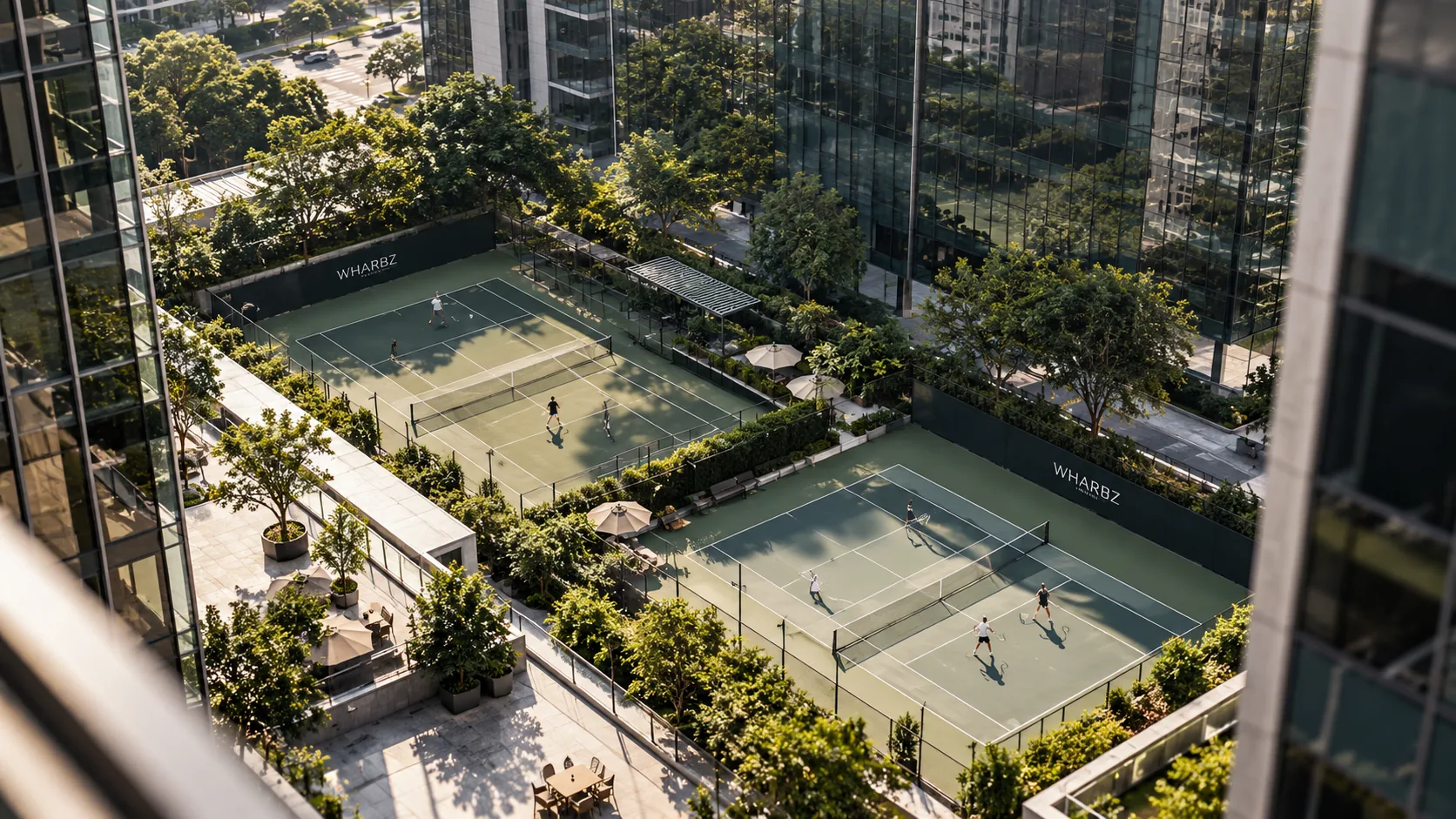
Clay, grass or hard court: the same game changes with the court.
What tennis and its offshoots teach about strategy, relationships and choosing an address.
Wimbledon was born at a croquet club and stayed open to amateurs only for more than ninety years. Even so, tennis never stopped reinventing itself: today it shares the stage with beach tennis, padel, squash and pickleball, and it is bringing executives back to courts across São Paulo. For people who make business decisions, it teaches three things: the surface changes the game, what looks easy was prepared in advance, and some of the most important conversations happen between sets.
- Tennis was born exclusive: Wimbledon began in 1877 to pay for a roller for a croquet club's lawns, and only opened its doors to professionals in 1968.
- The sport keeps reinventing itself in more compact, more social formats: beach tennis, padel, squash and pickleball. Squash joins the Los Angeles Olympic Games in 2028.
- Decision-makers play too: Bill Gates, Larry Ellison and Richard Branson and, in Brazil, Jorge Paulo Lemann, who played the international circuit before becoming an investor.
- Roger Federer called his effortless reputation a myth: the ease was built in training. A good address decision also looks simple when the reading comes first.
- In 2017, Federer skipped the clay season and won Wimbledon for the eighth time. Choosing where to play is strategy, and a company can choose its surface too.
- In São Paulo, the court has become real estate: parking lots and plots awaiting construction turned into arenas, and brands brought courts close to their headquarters.
An elite sport, but not always
Wimbledon, the oldest tournament in tennis, began in 1877 with a prosaic goal: paying for a pony-drawn roller for a croquet club's lawns. For more than ninety years, only amateurs could play, a word that at the time meant gentlemen (Smithsonian Magazine).
- 1877The All England Croquet Club holds the first Wimbledon championship and renames itself the All England Croquet and Lawn Tennis Club. About 200 people watch.
- 1968The Open Era begins: professionals start playing the major tournaments.
- 2000Gustavo Kuerten, Roland Garros champion in 1997, 2000 and 2001, finishes the year as world No. 1 after winning the Masters in Lisbon (ATP Tour).
- 2024João Fonseca wins the Next Gen ATP Finals in Jeddah, aged 18 (ATP Tour).
The club is still there. What changed is that the court no longer has a single door.
In São Paulo, the president of the São Paulo State Tennis Federation, Danilo Gaino, describes the best moment for the sport since the Guga era, with CEOs of large companies among the players entering the federation's tournaments (Times Brasil, 2026, paraphrased).
A sport that keeps reinventing itself
Tennis has gained more compact, more social formats that fit into less space. Some were born from improvisation.
Beach tennis
It emerged in the 1970s on the beaches of Ravenna, Italy. The International Tennis Federation has run a tour since 2008, and Brazil hosted its Beach Tennis World Cup in 2024. In São Paulo, it left the beach and reached Faria Lima.
ITFPadel
Born in 1969 in Acapulco, Mexico, when Enrique Corcuera built a smaller court in a backyard with no room for a tennis court. From his house, it traveled to Spain and Argentina.
International Padel FederationSquash
Played on a compact, enclosed court, it joins the program of the Los Angeles 2028 Olympic Games, approved by the International Olympic Committee in 2023.
IOCPickleball
Created in 1965 on Bainbridge Island, in the United States, by friends of Bill Gates's father. Gates has played it for more than 50 years, on a court his father built at home.
GeekWireSmaller courts, often doubles, and a break that ends in conversation. That is how these courts reached the cities.
Decision-makers play too
Some of the best-known names in business take tennis seriously, and not only as leisure.
Bill Gates
He played doubles with Roger Federer at a charity match in Seattle in 2017, and practiced for it. He wrote the introduction to the 50th anniversary edition of The Inner Game of Tennis, a 1974 book whose author is seen as the father of modern coaching.
CNBC · Penguin Random HouseLarry Ellison
The Oracle co-founder swapped basketball for tennis, practiced day after day with former pro Sandy Mayer and became a good recreational player. In 2009, he bought the Indian Wells tournament and the 55 acres it is played on.
Tennis.com · Tennis.comRichard Branson
He wakes up around 5 a.m. and, among his morning options, is a game of tennis before breakfast (paraphrased from his post on the Virgin blog, 2017).
VirginJorge Paulo Lemann
Before becoming one of Brazil's best-known investors, he played the international circuit, Wimbledon included. In 2002, he founded Instituto Tênis with former player Nelson Aerts to develop new Brazilian players.
ForbesPedro Zannoni
Then CEO of Lacoste Latin America, he told Forbes that he entered the ATP rankings at 16 and that he brings from tennis to management planning by season and by surface, discipline and fair play (2021, paraphrased).
ForbesRené Lacoste
Winner of seven Grand Slam titles in the 1920s, he was nicknamed the crocodile by the American press for his tenacity. In 1933, he founded the brand with André Gillier and launched the piqué polo shirt that replaced the stiff shirts of the time.
LacosteOn court, a job title does not return the ball.
A study that followed more than 8,000 Danes for about 25 years linked tennis to the largest gain in life expectancy among the sports assessed, ahead of running, cycling and the gym. The authors point to social interaction as part of the explanation (Mayo Clinic Proceedings, 2018, via ITF and AARP).
Looking easy takes work.
In his 2024 commencement speech at Dartmouth College, in the United States, Roger Federer called the idea that he played without effort a myth. He described years of outbursts on court, racket throwing included, before he learned to stay calm (paraphrased).
Over his career, he won almost 80% of the 1,526 singles matches he played, with 54% of the points. Perfection was never the measure; consistency was.
“The truth is, I had to work very hard… to make it look easy.”
Roger Federer, commencement speech at Dartmouth, 2024
A good address decision also looks simple on moving day. It means the reading came first: of the operation, the team, the neighborhood and the lease. At Wharbz, that work stays on our side of the court.
- 1,526 singles matches
- Almost 80% of them won
- 54% of points won
- Consistency, not perfection.
The surface changes the game
On clay, the ball bounces high and slows down; rallies get long and call for patience. On grass, it skids low and fast, and points end early. Rafael Nadal won Roland Garros, on the clay of Paris, 14 times, with 112 wins and 4 losses (Roland-Garros). In 2017, at 35, Roger Federer went the other way: for the first time since 1998, he skipped the entire clay season, saying his calendar would decide how long he could keep playing (Boston.com, paraphrased). Two months later, he won Wimbledon for the eighth time without dropping a set (ATP Tour).
Even the best choose where to play. A company can choose its surface too. What defines a company's surface:
- The pace of the operation. A team that receives clients every day plays on a different surface from a team that meets twice a week.
- Who needs to get there. Staff, clients and candidates: where they come from, by what transport and how long it takes.
- Room to grow. Growing in the same building, taking the floor above, or moving again in three years.
- What the address says. The neighborhood, the façade and the building say who the company is before the first meeting.
- The cost of occupancy. Rent, service charges, property tax (IPTU), fit-out and the move over the whole lease, not just the price per square meter.
That is why the first conversation with Wharbz is about your game, not about the court that happens to be available.
When the court becomes real estate
In São Paulo, beach tennis grew close to the offices. In 2022, Bloomberg Línea reported that parking lots and plots awaiting construction around Faria Lima had become courts, that companies were booking them for their teams, and that deals were being pitched after the match (Bloomberg Línea).
- Faria Lima, 2022XP opened a beach tennis complex of about 4,000 m² on a former parking lot on Avenida Brigadeiro Faria Lima (Brazil Journal).
- Itaim Bibi, 2022BTG put its name on five courts a ten-minute walk from its headquarters, used by staff and clients and treated as a relationship tool. Staff nicknamed it the bank's backyard (Bloomberg Línea).
- Chucri Zaidan, 2026Smash Courts, a 5,000 m² tennis complex with pickleball courts, opened with a view of the Ponte Estaiada bridge and presents itself as a tennis and networking club (Forbes).
- ResidentialWith club courts in high demand, a tennis court has become a selling point for high-end residential developments, according to the São Paulo State Tennis Federation (Times Brasil, 2026).
A plot awaiting construction can earn income as a court for a few years. The lease decides whether that is income or a problem: the term, vacating the site, who keeps the structure at the end and what the neighbors will hear at ten at night. In São Paulo, noise from businesses is policed by Psiu, the city's urban silence program.
For anyone opening an arena, the reading is the same as for any street property: zoning, licensing, access, parking and neighbors, before the surface.
What people ask about tennis and business
Sources
- Smithsonian Magazine: A Brief History of Wimbledon
- ATP Tour: Kuerten, the number one profile
- ATP Tour: Fonseca wins the Next Gen ATP Finals (2024)
- Times Brasil: Tênis cresce com novos ídolos, networking e interesse de marcas, diz presidente da Federação Paulista (2026)
- ITF: World Tennis Beach Tennis Information Pack (2026)
- International Padel Federation: History
- International Olympic Committee: five additional sports for LA28 (2023)
- GeekWire: Bill Gates on his pickleball past (2022)
- CNBC: Bill Gates and Roger Federer played tennis for charity (2017)
- Penguin Random House: The Inner Game of Tennis, 50th Anniversary Edition
- Tennis.com: Newcomer of the year, Larry Ellison
- Tennis.com: Indian Wells confirms Ellison as new owner (2009)
- Virgin: My (usual) daily routine, Richard Branson (2017)
- Forbes: Conheça o esforço de Lemann para criar uma nova geração de tenistas brasileiros (2017)
- Forbes: Como Pedro Zannoni usa estratégias do tênis para comandar a Lacoste América Latina (2021)
- Lacoste: Our history
- ITF: Playing tennis can increase life expectancy by 10 years
- AARP: Tennis helps life expectancy (2018)
- Dartmouth: Roger Federer at Dartmouth Commencement (2024)
- Kottke: A few lessons from Roger Federer's Dartmouth commencement speech (2024)
- Roland-Garros: Rafael Nadal, 14 Roland-Garros in numbers
- Boston.com: Roger Federer decides to skip the French Open (2017)
- ATP Tour: Wimbledon 2017 final, Federer and Cilic
- Bloomberg Línea: Os Faria Limers estão obcecados com beach tennis (2022)
- Brazil Journal: Arena XP, a praia dos paulistanos no coração da Faria Lima (2022)
- Bloomberg Línea: “Quintal do banco”: BTG aposta em quadras de beach tennis no coração da Faria Lima (2022)
- Forbes: Smash Courts quer ser o novo clube de tênis da Faria Lima (2026)
- Prefeitura de São Paulo: Psiu, programa de silêncio urbano (2017)
What is your company's game? Let's start there.
Talk to an advisor