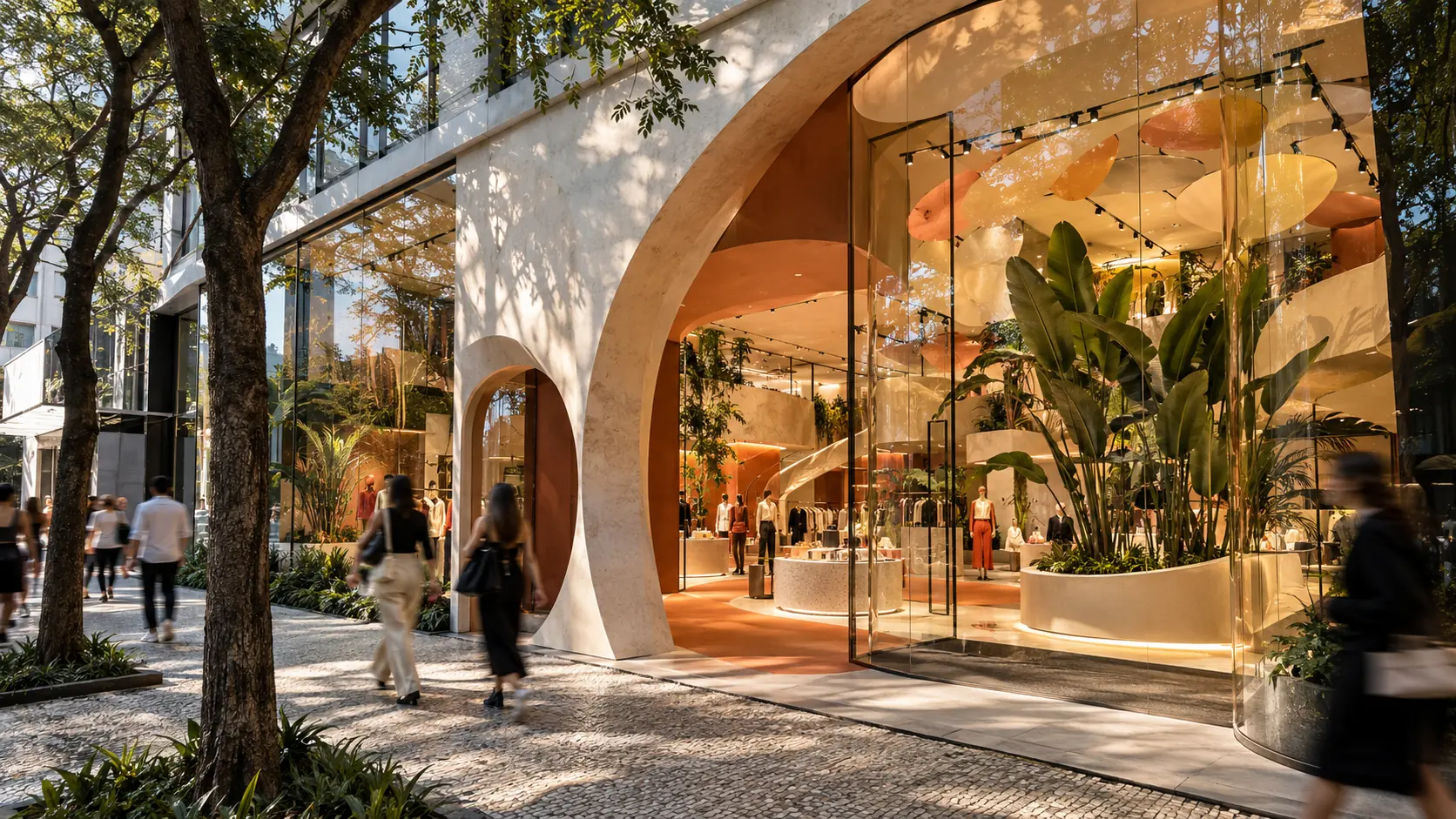
Flagship stores: when the rent comes out of the marketing budget
The store a brand opens to be seen. Who pays for it, when it is read as media and what changes when you choose the property.
A flagship is the store a brand opens to be seen, not just to sell. That is why some companies approve and measure it as media: the rent is weighed against other ways of being seen, and the return is counted across the brand's sales, online included. For whoever chooses the property, the question changes: not how much the store sells per square meter, but how much it makes the brand sell.
- A flagship is a brand's main store, designed to show who the brand is. The name comes from the ship that flies the fleet commander's flag.
- The brand pays, and there are three ways to do the math: by the store's own sales, by splitting it with marketing, or as a brand investment. The contract is an ordinary lease in all of them.
- The return shows up outside the store's till: online sales in the area, customers' photos and posts, press coverage and the store network.
- In São Paulo, the Clean City Law limits signage on façades. Architecture and the shop window do the work a sign cannot.
- A flagship invests heavily in design and fit-out. Term, a rent-free period for the works and the right to renew are worth as much as the rent itself.
- Choosing the property starts with the goal and the yardstick for return, set by marketing and expansion together.
What a flagship is (and what it is not)
A flagship, or concept store, is the store a brand treats as its main showcase. The term comes from the navy: the flagship is the vessel that carries the commander's flag. In practice, it is the address where a brand shows what it is, tests what comes next and welcomes those who want to know it up close.
| Aspect | Flagship | Standard store | Pop-up |
|---|---|---|---|
| What it is for | Showing the brand, testing formats, starting conversations | Selling efficiently | Creating a moment: a launch, a collection, a date |
| How long | Years, on a long lease | Years | Weeks or months |
| How it is measured | Effect on the brand and on sales across all channels | Sales per square meter and margin | Reach, content and sales in the period |
| Who runs it | The brand itself | The brand or a franchisee | The brand, alone or with partners |
Who pays the bill, and why
The brand pays. The difference is the yardstick: a standard store has to pay for itself with what it sells; a flagship does not, necessarily.
In a Mercado&Consumo report on São Paulo's concept stores, a retail consultant explained that brands invest heavily in these spaces without expecting them to turn a profit, and that the return can be measured by online sales within a 2 km radius (paraphrased).
“a flagship does not exist to maximize direct sales, but to maximize perceived value”
Carolina Cândido, Gouvêa Consulting, in a Mercado&Consumo article (2026), our translation
Lee Peterson, of WD Partners, described the flagship as a billboard that sends customers to buy online (Retail Dive, 2020, paraphrased). In New York, luxury brands went as far as buying the buildings that house their main stores, so as not to depend on a lease renewal or leave room for a competitor (Modern Retail, 2024).
- The store's own sales
- Sales beyond the store. In the United States, an ICSC study (2018) measured an average 37% rise in a brand's website traffic in the area in the quarter after a store opened.
- Media made by customers. Photos, videos and posts take the store to people who never walked down the street.
- Media the store attracts. Press, events, launches, even a TV drama.
- A standard for the network. Layout, service and product tested before they reach the other stores.
- Rent weighed against media, not against another rent
Not every flagship comes out of the marketing budget
In the books, the lease is the same in all three cases. What changes is the internal decision: who approves it, which budget the money comes from and against which yardstick the store is measured.
The flagship that pays its way
It sits in the commercial budget and is measured by sales, like any other store, only at a better address. It makes sense when the location sells strongly on its own. In a 2017 Bisnow report, a retail real estate advisor said new flagships from Hermès, Chanel and Prada would almost always be profitable (paraphrased).
BisnowThe split bill
What a standard store would cost at that location stays in the commercial budget. Anything above that, such as the pricier address, the architecture and the experience area, counts as a brand investment. In the same report, Coach's vice president of real estate said that in very high-rent, high-traffic locations, companies sometimes put a number on the benefit of being there, next to other big names (paraphrased).
BisnowThe flagship as media
The brand invests without expecting the space itself to turn a profit and measures the return through the brand and sales across all channels. That is the logic described in Mercado&Consumo's report on São Paulo's concept stores. At Casa Dexco, the space is presented by the company's Marketing and Design team.
Mercado&Consumo · Mercado&ConsumoChoosing the model comes before choosing the property: it defines the address, the lease term and the yardstick for return.
The store made to be photographed
Some stores are designed to become images. On Rua Oscar Freire, this is already a tradition.
Havaianas
In 2021, the brand reopened its Oscar Freire concept store with a sensory ramp, a customization counter and a space the press called “Instagrammable”. In 2023, it said around 80% of the store's visitors were tourists.
Exame · Mercado&ConsumoGaleria Melissa
For more than fifteen years, it has moved from one exhibition to the next, with settings designed to be photographed and shared. Its façade was once covered entirely in Post-its.
ABC da ComunicaçãoLego
In early 2026, it opened its largest store in Latin America on Oscar Freire, with a life-size McLaren Formula 1 car made of around 400,000 pieces, on display for a limited time.
Mercado&ConsumoWhat they share: the store produces the content, and the customer handles distribution.
The Clean City Law (Municipal Law 14,223/2006) limits signage on façades. A brand cannot solve visibility with a bigger sign. Architecture, the shop window, lighting and the movement at the door do the talking. That is why the property's frontage, the corner and the ceiling height weigh as much as the address.
Beyond fashion: chocolate, telecoms, retail and food
- KopenhagenThe Brazilian chocolate maker opened its first concept store on Oscar Freire in 2013 (Gironews). In 2021, it opened a store in Itaim Bibi with a café, self-service and a gift customization area (Mercado&Consumo); in 2023, its second flagship, on Rua dos Pinheiros (Dicas de Sampa); in 2024, it reopened the Oscar Freire store in the café format (Mercado&Consumo).
- DengoFábrica Dengo, on Avenida Brigadeiro Faria Lima in Pinheiros, fills four floors with a bean-to-bar route, a café, a restaurant and a bar (Mercado&Consumo).
- VivoThe telecom operator's concept store on Oscar Freire mixes social space, culture and technology, with Café Vivo, and became a set for the TV Globo drama “Três Graças” in 2026 (Creativos BR).
- MagaluGaleria Magalu, on Avenida Paulista, works as a retail media platform, with 77 screens and LED panels (All Connected).
- La PastinaCasa La Pastina, on Oscar Freire, brings together a delicatessen, a café, a wine bar and a restaurant over two floors (Mercado&Consumo).
In every case, the store sells. But sales are not what justify the address.
When the one who decides is not the one who buys
In some sectors, the flagship speaks first to whoever recommends: the architect, the designer, the family visiting the school.
Architecture and materials
Dexco (Deca, Portinari, Duratex and other brands) opened Casa Dexco in 2025 at Conjunto Nacional, on Avenida Paulista: around 4,000 m² over two floors, with an architects' showcase, a café and exhibitions. The same year, it announced a free coworking space there for architects and designers. The space is presented by the company's Marketing and Design team.
Mercado&Consumo · Mercado&ConsumoFurniture
Alameda Gabriel Monteiro da Silva is known as São Paulo's street for interiors and furniture design, frequented by architects and decorators. In 2026, Evviva, the custom furniture brand of Grupo Bertolini, opened a 700 m² flagship there for architects, designers and clients, announced as part of the brand's franchise network.
Ma Stump · Silvana ToazzaEducation
In schools and education networks, the flagship usually goes by another name: the model school. It is the one families visit before enrolling and where the network trains its teachers. What weighs: safety around the building, drop-off and pick-up, transport access, and the specific licensing and fire safety requirements for school use.
In these cases, the flagship's return shows up in referrals and visits more than in the day's takings.
What changes when you choose the property
When the store is media, the property is chosen the way media is chosen: by audience, framing and context.
- Who walks by and who posts. Foot traffic counts. So do the people who are there to stroll, take pictures and share them, such as tourists and the weekend crowd.
- The façade as a frame. Frontage width, corner position, ceiling height, sidewalk room for the photo, natural light and visibility from a distance.
- The neighbors. The brands next door help tell people who you are. Or get in the way.
- The street's hours. A weekend street, a night street, a business-hours street: each one serves a different strategy.
- What the rules allow. The Clean City Law on the façade, permits, fire safety certification (AVCB or CLCB) and accessibility, before the design is drawn.
- Fit-out and operations. Loading and unloading, stock, events and room for a queue at the door.
- A lease that matches the investment. A flagship invests heavily in design and fit-out. Term, a rent-free period for the works and the right to renew are worth as much as the rent itself. Under Brazil's Tenancy Law (Law 8,245/1991, art. 51), court-ordered renewal requires a written, fixed-term lease, at least five years of lease (uninterrupted terms added together) and three years in the same line of business. The claim must be filed between one year and six months before the lease ends. In franchise networks, it is worth deciding early who signs the lease: when the franchisor signs and subleases the location to the franchisee, either of them may seek renewal (Law 13,966/2019, art. 3).
How to measure the return
The yardstick has to exist before the lease is signed. Without it, a flagship is just expensive rent.
| Metric | What it shows |
|---|---|
| Brand sales in the area, across all channels | The store's effect beyond its own till |
| Website and app traffic in the area | Who the store sent online |
| Photos, mentions and customer-made content | The media the store produces |
| Press and events | The media the store attracts |
| Visits, dwell time and new customers | The store as a meeting place |
| Use by the network: training, launches and tests | The store as a lab |
Brand metrics such as awareness, consideration and satisfaction complete the picture.
Before the address, the study
Wharbz starts with the question, not the property. With your marketing and expansion teams at the same table, we define what the store has to deliver and how its return will be measured. Only then do we take to the street.
Goal and yardstick
Selling, being seen, testing, welcoming specifiers: the weight of each defines the property.
Street map
Which São Paulo addresses fit the goal and the audience, with a reading of each district.
Reading the façade
Framing, visibility, neighbors and what the Clean City Law allows.
Visits on a short list
Only what passed the criteria.
Negotiation
Term, a rent-free period for the works, renewal and the terms that protect the investment. For franchise networks, also who signs the lease.
You take a study to your board, not a list of properties. See what you receive.
What people ask before opening a flagship
Sources
- Exame: Havaianas reinaugura loja conceito “instagramável” em São Paulo (2021)
- Mercado&Consumo: Flagships e lojas-conceito de encher os olhos em São Paulo (2023)
- Mercado&Consumo: Flagship não é canal. É estratégia de marca, mercado e crescimento (2026)
- Mercado&Consumo: Lego inaugura maior loja da América Latina na Rua Oscar Freire (2026)
- Mercado&Consumo: Kopenhagen inaugura loja-conceito focada na experiência do consumidor (2021)
- Mercado&Consumo: Kopenhagen reabre as portas da loja na Rua Oscar Freire (2024)
- Gironews: Kopenhagen expande formato de luxo (2014)
- Dicas de Sampa: Kopenhagen inaugura flagship em Pinheiros (2023)
- ABC da Comunicação: Melissa celebra mais de 15 anos de galerias em NYC e São Paulo (2021)
- Creativos BR: Vivo apresenta sua loja conceito da Oscar Freire na novela “Três Graças” (2026)
- All Connected: Magalu transforma flagship em canal de mídia (2026)
- Mercado&Consumo: Dexco inaugura flagship na Av. Paulista (2025)
- Mercado&Consumo: Casa Dexco lança coworking gratuito para arquitetos e designers (2025)
- Ma Stump: Alameda Gabriel Monteiro da Silva, rua da decoração em SP
- Silvana Toazza: Grife de móveis da Serra Gaúcha inaugura flagship em endereço nobre de SP (2026)
- Retail Dive: What's in a flagship? (2020)
- Bisnow: Luxury retailers sometimes lose money to gain cachet at flagships (2017)
- ICSC: The Halo Effect, how bricks impact clicks (2018)
- Modern Retail: Luxury brands become landlords to take control in coveted retail destinations (2024)
- Planalto: Lei 13.966/2019 (Lei de Franquias)
- Planalto: Lei 8.245/1991 (Lei do Inquilinato)
Shall we study your flagship together?
Talk to an advisor